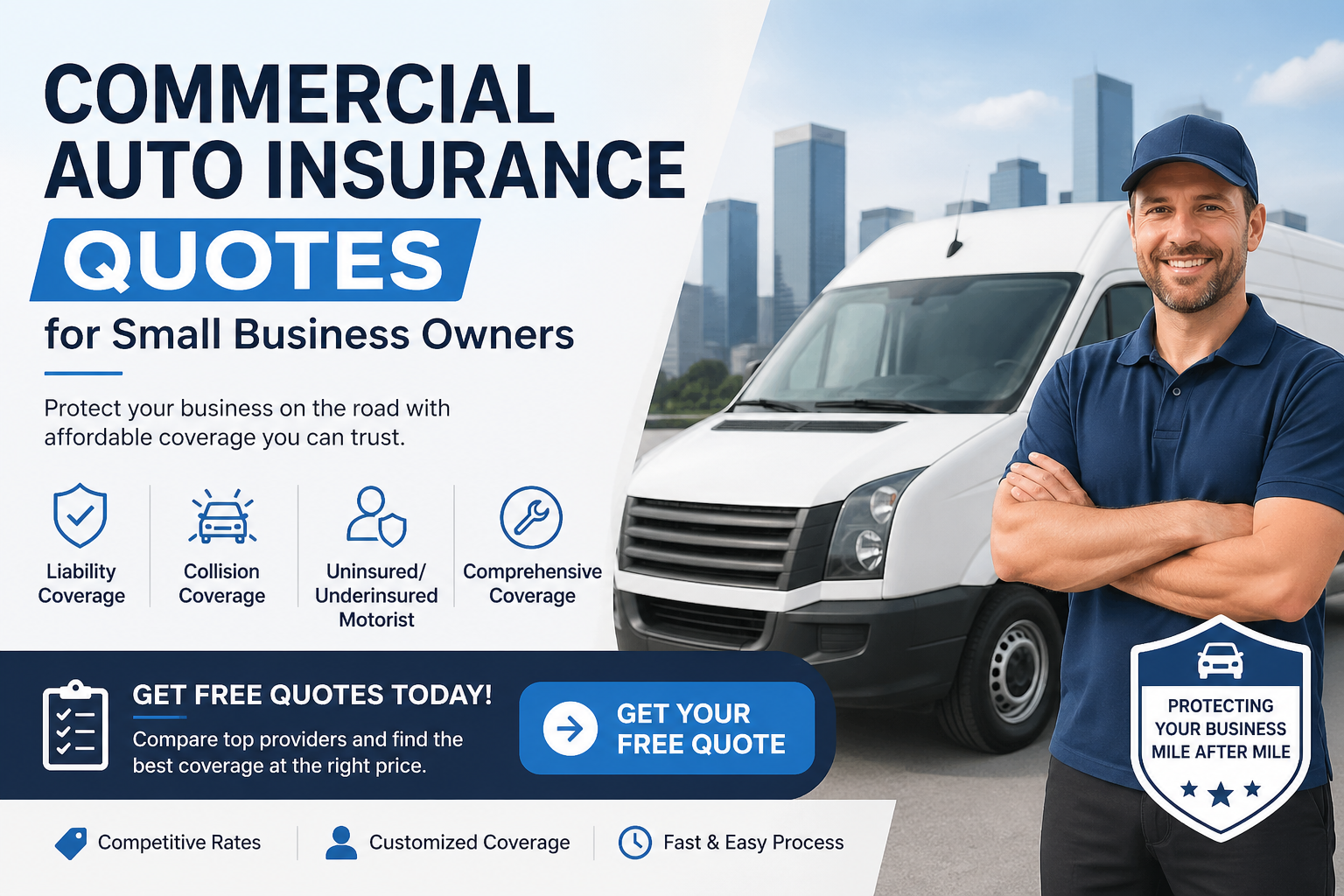
Commercial Auto Insurance Quotes for Small Business Owners 2026: How to Get the Best Rates & Coverage
Fact: The average small business pays between $150 and $1,200 per month per vehicle for commercial auto insurance in 2026 . But here is the truth most agents won’t tell you: Two identical businesses can receive quotes that differ by hundreds of dollars per month for the exact same coverage.
If you are a small business owner who uses vehicles for work—whether you run a landscaping company, a cleaning service, a contracting business, or a food truck—you cannot afford to rely on your personal auto policy. One accident during work hours could leave you personally liable for tens of thousands of dollars in damages.
This guide covers exactly how commercial auto insurance works in 2026, what you should expect to pay, which carriers offer the best coverage, and most importantly—how to get accurate quotes without overpaying.
Part 1: Do You Actually Need Commercial Auto Insurance?
This is the most common mistake small business owners make. They assume their personal auto policy covers business use. It does not.
The Personal vs. Commercial Distinction
Personal auto insurance is designed for everyday driving—commuting, running errands, road trips, and personal travel . Commercial auto insurance is specifically designed for work-related activities .
You typically need commercial auto insurance if:
- The vehicle is titled or registered to your business (LLC, corporation, or sole proprietorship)
- Your employees drive the vehicle for work purposes (even occasionally)
- You deliver goods, haul equipment, or transport materials as part of your paid work
- You transport people for a fee (rideshare, shuttle, taxi)
- You need to provide Certificates of Insurance (COIs) to customers or vendors
- You carry heavy tools, equipment, or inventory in the vehicle
The “Occasional Use” Trap
Many business owners believe that if they only use their personal car for business “occasionally,” their personal policy will cover them. This is incorrect. Most personal auto policies specifically exclude coverage for any accident that occurs while the vehicle is being used for commercial purposes . If you cause an accident while picking up supplies for a client or driving to a job site, your claim can be denied entirely.
What About Hired and Non-Owned Auto (HNOA)?
If your employees drive their own personal vehicles for work (running errands, visiting clients, making deliveries), you need Hired and Non-Owned Auto coverage . This covers your business liability when an employee causes an accident in their personal car while working for you. Your employee’s personal insurance may not cover business use either, leaving your business exposed.
Who Specifically Needs Commercial Auto Insurance?
Based on Insureon’s 2026 data, these industries most commonly require commercial auto coverage :
| Industry | Why They Need It | Recommended Providers |
|---|---|---|
| Contractors (plumbing, electrical, construction) | Hauling tools/materials; multiple job sites daily | The Hartford, Progressive |
| Cleaning Services | Transporting equipment (vacuums, buffers, chemicals) | Progressive, Travelers |
| Landscaping | Trailers, mowers, leaf blowers; frequent highway travel | Acuity, Progressive, The Hartford |
| Auto Services (repair shops, tow trucks) | Customer vehicles in your care; test drives | Progressive (garage keepers coverage) |
| Retail (delivery) | Regular delivery routes; company vehicles | The Hartford, Progressive |
| Consulting | Visiting client offices; company cars or personal cars | The Hartford, Progressive, Travelers |
Part 2: What Commercial Auto Insurance Actually Covers
Before you start comparing quotes, you need to understand what you are buying. A standard commercial auto policy includes several components .
Required Coverages (Liability)
Bodily Injury Liability: Covers medical expenses, lost wages, and legal fees if you or an employee causes an accident that injures someone else. Most experts recommend at least $500,000 to $1,000,000 in coverage .
Property Damage Liability: Covers repairs to another person’s vehicle or property (fences, buildings, etc.) if you are at fault.
Required by law in every state. However, state minimums are almost never enough. Many commercial contracts require $1,000,000 in combined single limit (CSL) coverage .
Physical Damage Coverages (Optional but Recommended)
Collision Coverage: Pays to repair or replace your vehicle if you crash into another vehicle or object, regardless of who is at fault . Usually required if the vehicle is financed or leased.
Comprehensive Coverage: Pays for damage from non-collision events—theft, vandalism, fire, weather, hitting an animal .
Additional Coverages to Consider
Uninsured/Underinsured Motorist (UM/UIM): Protects you if an at-fault driver has no insurance or insufficient coverage. Required or offered in most states .
Medical Payments (MedPay) or Personal Injury Protection (PIP): Covers medical bills for you and your employees regardless of fault. PIP may also cover lost wages .
Hired Auto Coverage: Covers physical damage to vehicles you rent or lease for business use .
Non-Owned Auto Coverage: Covers liability when employees use their personal vehicles for work .
Towing and Roadside Assistance: Covers flat tires, dead batteries, lockouts, and towing .
Auto Lease/ Loan Gap Coverage: Pays the difference between the vehicle’s actual cash value and what you owe on a loan if the vehicle is totaled .
Part 3: Commercial Auto Insurance Costs in 2026 (By Vehicle Type & Risk Level)
Commercial auto remains one of the toughest insurance lines in 2026. most fleets should still budget for above-average increases, especially if they have recent at-fault accidents or operate heavy vehicles in dense urban areas .
Monthly Cost Ranges Per Vehicle
Based on 2026 data from multiple sources, here is what you can realistically expect to pay :
| Risk Tier | Typical Business Profile | 2026 Monthly Range (Per Vehicle) | Annual Range |
|---|---|---|---|
| Lower-Risk | Clean driving records, limited operating radius (local only), light vehicle use, no prior claims | $100 – $300 | $1,200 – $3,600 |
| Mid-Risk | Mixed driver records, moderate mileage, regional operations, standard claims exposure | $300 – $600 | $3,600 – $7,200 |
| Higher-Risk | Delivery/courier services, dense urban garaging, prior accidents or violations, high liability limits | $600 – $900+ | $7,200 – $10,800+ |
How Vehicle Type Affects Your Rate
Different vehicle classes come with different risk profiles and therefore different premiums :
| Vehicle Class | Typical Monthly Range | Why the Cost Differs |
|---|---|---|
| Sedan / Small SUV | $100 – $250 | Lower risk when used for low-mileage business errands |
| Pickup Truck | $200 – $500 | Hauling tools/materials increases risk; higher mileage |
| Cargo Van / Service Van | $300 – $700 | Higher mileage, theft risk, equipment loads |
| Box Truck | $400 – $900+ | Larger vehicle = more damage in an accident |
| Newer Vehicle (with ADAS) | Varies significantly | Repairs cost more (sensors + calibration) |
Factors That Drive Your Premium (What Insurers Actually Look At)
Underwriters calculate commercial auto rates based on several key factors :
1. Driver Records (MVRs – Motor Vehicle Reports) – The single biggest factor. Drivers with speeding tickets, at-fault accidents, or DUIs will dramatically increase your premium. One bad driver can double your fleet’s insurance cost.
2. Vehicle Type and Value – Newer, more expensive vehicles cost more to repair or replace. Vehicles with Advanced Driver Assistance Systems (ADAS) require expensive recalibration after even minor accidents .
3. Operating Radius – “Local only” (within 50 miles) costs significantly less than regional or long-haul operations . Be honest about your radius—insurance companies verify this through GPS and mileage logs.
4. Annual Mileage – Higher mileage = higher accident risk. Underestimating your mileage is insurance fraud and will void your claim.
5. Garaging ZIP Code – Where you park your vehicles overnight is a major rating factor. Urban areas with higher theft and accident rates cost more than rural locations .
6. Business Use Type – Delivery and courier services pay more than sales calls or client visits .
7. Claims History – One at-fault accident can increase your rates for 3-5 years. A pattern of claims can make you uninsurable with standard carriers.
8. Coverage Limits and Deductibles – Higher liability limits cost more. Higher deductibles lower your premium but increase your out-of-pocket cost after an accident.
Part 4: Top Commercial Auto Insurance Providers for 2026
Based on Insureon’s 2026 analysis (updated March 2026), these are the best-rated commercial auto insurers for small businesses :
The Hartford
- AM Best Rating: A+
- Customer Rating: 4.8/5 for claims
- Focus: Experience, reliability, customized policies
- Coverage Area: Nationwide (excluding Alaska and Hawaii)
- Best For: Contractors, landscapers, retailers, consultants
Progressive
- AM Best Rating: A+
- Focus: Affordability and comprehensive protection
- Coverage Area: Nationwide (excluding Washington, D.C.)
- Best For: Auto services (garage keepers), contractors, delivery drivers, food trucks
Acuity
- AM Best Rating: A+
- Customer Rating: 96% claims satisfaction
- Focus: Reliability, customer satisfaction, commercial truck insurance
- Coverage Area: 30+ states (Midwest focus)
- Best For: Landscaping, trucking
Liberty Mutual
- AM Best Rating: A (Excellent)
- Customer Rating: 90% highly satisfied with claims process
- Focus: Specialty vehicles (construction to food trucks)
- Coverage Area: Nationwide
- Best For: Construction, food trucks, specialty vehicles
Chubb
- AM Best Rating: A++ (highest rating)
- Customer Rating: 98% satisfaction rate
- Focus: Exceptional customer service and claims
- Coverage Area: Nationwide
- Best For: High-value fleets, large small businesses
Travelers
- Availability: All 50 states and Washington, D.C.
- Key Feature: Select Auto CoveragePlus add-ons (gap coverage, blanket additional insured, employee hired auto)
- Note: Cannot purchase coverage online—must go through an agent
Part 5: How to Get Accurate Commercial Auto Insurance Quotes (7-Step Process)
Shopping for commercial auto insurance is different from personal insurance. You need preparation. Here is the 2026 step-by-step process :
Step 1: Gather Your Information (The 5-Minute Checklist)
Before you request a single quote, collect these documents. Missing information will delay your quote or result in inaccurate pricing.
Business & Driver Details:
- Legal business name (exactly as registered with your state)
- Business address and garaging ZIP code(s) for each vehicle
- EIN (Employer Identification Number)
- Driver roster: Full name, date of birth, driver’s license number and state, years licensed for each driver
- Prior claims and violations for the past 3-5 years
Vehicle Details:
- VIN (Vehicle Identification Number) for each vehicle
- Year, make, model
- Vehicle class and weight
- Ownership status (owned, financed, or leased)
- Annual mileage for each vehicle
- Operating radius (local, regional, national)
Contract Requirements (if applicable):
- Required liability limits from customers or brokers
- Additional insured requirements
- Certificate of Insurance (COI) delivery method
Pro tip: Keep your prior insurance policy handy. Continuous coverage often prices better than “no prior” coverage and can reduce surprise down payments .
Step 2: Confirm You Need Commercial (Not Personal) Coverage
If any of these apply, you need commercial coverage:
- The vehicle is titled to your business
- Employees drive the vehicle
- You deliver goods, haul equipment, or transport clients
- You need certificates of insurance for customers
If none of these apply, you may only need a personal policy with a business use endorsement (which is different from full commercial coverage).
Step 3: Choose Your Coverages and Limits
Start with liability (most contracts require $1,000,000 CSL). Then decide on physical damage based on vehicle value and financing status .
Minimum recommended coverage for most small businesses:
- Liability: $500,000 to $1,000,000 CSL
- Comprehensive and Collision: Deductibles of $500 to $1,000
- Uninsured/Underinsured Motorist: Match your liability limit
- Medical Payments: $5,000 to $10,000 per person
Step 4: Set Deductibles You Can Actually Afford
A higher deductible lowers your monthly premium. But the real test is whether you can pay that deductible and keep operating after a loss .
Example: If a $2,500 deductible would park your truck for a week while you scrape together the cash, the “savings” on premium is not worth the risk. Choose a deductible you can cover from your business checking account tomorrow.
Step 5: Get Multiple Quotes and Compare Them Apples-to-Apples
This is where most business owners make mistakes. You cannot compare a quote with $500,000 liability to a quote with $1,000,000 liability and choose the cheaper one. You are comparing different products.
Use this apples-to-apples comparison method :
- Same liability limits on every quote
- Same comprehensive/collision deductibles
- Same drivers listed
- Same business use description (mileage, radius, cargo type)
- Same coverage add-ons (towing, rental reimbursement, etc.)
Where to get quotes:
- Insureon (digital agency): Compares 40+ carriers, helped over 450,000 small businesses
- Progressive Commercial : Direct online quotes
- Local independent agents: Can access niche carriers not available online
- The Hartford : Strong for contractors and service businesses
Step 6: Answer Underwriting Questions Honestly
Online forms commonly ask about :
- Where the vehicle is garaged overnight
- Who drives it and how often
- What you transport (tools, materials, hazardous goods, passengers)
- Where you operate (local ZIP codes, regional, national)
- Prior losses or violations
Do not “optimize” answers to chase a lower number. Insurance companies run MVR reports and loss history reports. Any discrepancy will result in:
- Delays in binding (sometimes weeks)
- A higher re-quote after underwriting review
- Policy cancellation (with a mark on your record)
Step 7: Bind Coverage, Pay, and Download Your Proof of Insurance
After you choose a policy, binding means the coverage becomes effective at a specific date and time after payment and acceptance .
Immediately after binding, download:
- Insurance ID cards (keep in each vehicle)
- Declarations page
- Billing schedule
- Certificate of Insurance (COI) if required by customers
Set up autopay to avoid accidental lapses. Even a one-day lapse in coverage can increase your rates significantly for years .
Part 6: How to Lower Your Commercial Auto Insurance Premiums (Without Underinsuring)
Rates are rising in 2026, but you have levers to pull :
1. Implement Telematics (Usage-Based Insurance)
Carriers are rewarding fleets that use telematics devices or apps to track driving behavior—hard braking, speeding, acceleration, mileage . Safe driving scores can reduce premiums by 10-25%.
2. Enforce Strict Driver Hiring Standards
One driver with a DUI or multiple at-fault accidents can double your fleet’s premium. Implement MVR checks before hiring and annually thereafter.
3. Document Vehicle Maintenance Schedules
Carriers look favorably on documented maintenance. Regular brake, tire, and light inspections reduce accident risk .
4. Increase Deductibles Strategically
Moving from $500 to $1,000 deductible often reduces premium by 10-15%. Only do this if you have the cash reserve to cover the higher deductible.
5. Pay Annually Instead of Monthly
Monthly billing often includes installment fees. Paying the full annual premium can save 5-10% .
6. Bundle Policies (BOP – Business Owner’s Policy)
Combine commercial auto with general liability, property, or workers’ compensation from the same carrier. Multi-policy discounts typically range from 5-15% .
7. Reduce Mileage and Radius Where Possible
If you can shift some work to “local only” (under 50 miles), your rate class may decrease significantly.
8. Maintain Continuous Coverage
Never let your policy lapse. Lapses signal higher risk to underwriters and can increase rates by 20-40%.
Part 7: Common Mistakes That Cost Small Business Owners Thousands
Mistake #1: Using Personal Auto Insurance for Business Use
If you cause an accident while working and file a claim on your personal policy, the insurer will investigate. They will ask: “Were you working at the time?” If the answer is yes, they can deny the claim entirely. You are then personally liable for all damages .
Mistake #2: Underestimating Annual Mileage
Giving a lower mileage estimate to get a cheaper premium is common—and common grounds for claim denial. Insurers verify mileage through service records, GPS, and telematics.
Mistake #3: Ignoring HNOA Coverage
If an employee drives their personal car to make a delivery for you and causes an accident, your business can be sued. Without Hired and Non-Owned Auto coverage, you have no protection .
Mistake #4: Buying the State Minimum Liability
State minimums are dangerously low (often $25,000 or $50,000). A single accident with injuries can easily exceed $500,000 in damages. You could lose your business.
Mistake #5: Not Getting Multiple Quotes
Rates vary dramatically between carriers for the exact same risk. Always get at least 3-5 quotes and compare apples-to-apples .
Summary: Your 2026 Commercial Auto Insurance Action Plan
| Step | Action | Timeline |
|---|---|---|
| 1 | Determine if you need commercial coverage (vs. personal with business use) | Day 1 |
| 2 | Gather driver MVRs, VINs, garaging ZIPs, and mileage estimates | Day 1-2 |
| 3 | Set your coverage limits (minimum $500k liability, preferably $1M) | Day 2 |
| 4 | Get quotes from 3-5 carriers (The Hartford, Progressive, local agents) | Day 2-5 |
| 5 | Compare apples-to-apples (same limits, deductibles, drivers) | Day 5 |
| 6 | Choose the best value (not just the lowest premium) | Day 5 |
| 7 | Bind coverage, set up autopay, download ID cards and COIs | Day 5-7 |
The bottom line: Commercial auto insurance is not a commodity. The cheapest policy is worthless if it does not pay claims. The most expensive policy is unnecessary if you do not need the coverage. Find the balance by working with a reputable carrier or agent who understands your specific industry risks .
Remember: In 2026, commercial auto remains a hard market with rising rates . Start the shopping process at least 30-60 days before your current policy expires. Rushing almost always means overpaying.
Disclaimer: This article is for informational purposes only and does not constitute legal or financial advice. Insurance requirements, rates, and carrier offerings vary by state and individual business circumstances. Always consult with a licensed insurance agent or broker before purchasing any insurance policy.