Best High-Yield Fixed Income Investments for 2026: Why Tax-Free Bonds & CDs Are Beating the Market
Fact: A 6% taxable return is only worth 3.78% to a high-income earner in 2026. A 4% tax-free return, however, is actually worth 6.3% .
If you are looking at the stock market in 2026 and feeling uneasy about the AI bubble, the geopolitical headlines, or the “Magnificent Seven” volatility, you are not alone. High-net-worth US investors are quietly shifting billions into Fixed Income right now.
But here is the trick: You cannot just buy any bond or CD. You need the right ones.
In the current rate environment (Fed Funds hovering around 4.3% to 4.5%), two asset classes are dramatically outperforming on a risk-adjusted and after-tax basis: Municipal Bonds (Munis) and High-Yield Certificates of Deposit (CDs) .
We analyzed the top 10 highest-yielding, safest fixed-income vehicles for April/May 2026. If you are in a high tax bracket (32% to 40.8%), this guide could save you thousands of dollars in unnecessary IRS payments.
Part 1: The Case for Tax-Free Municipal Bonds (The “Invisible Yield”)
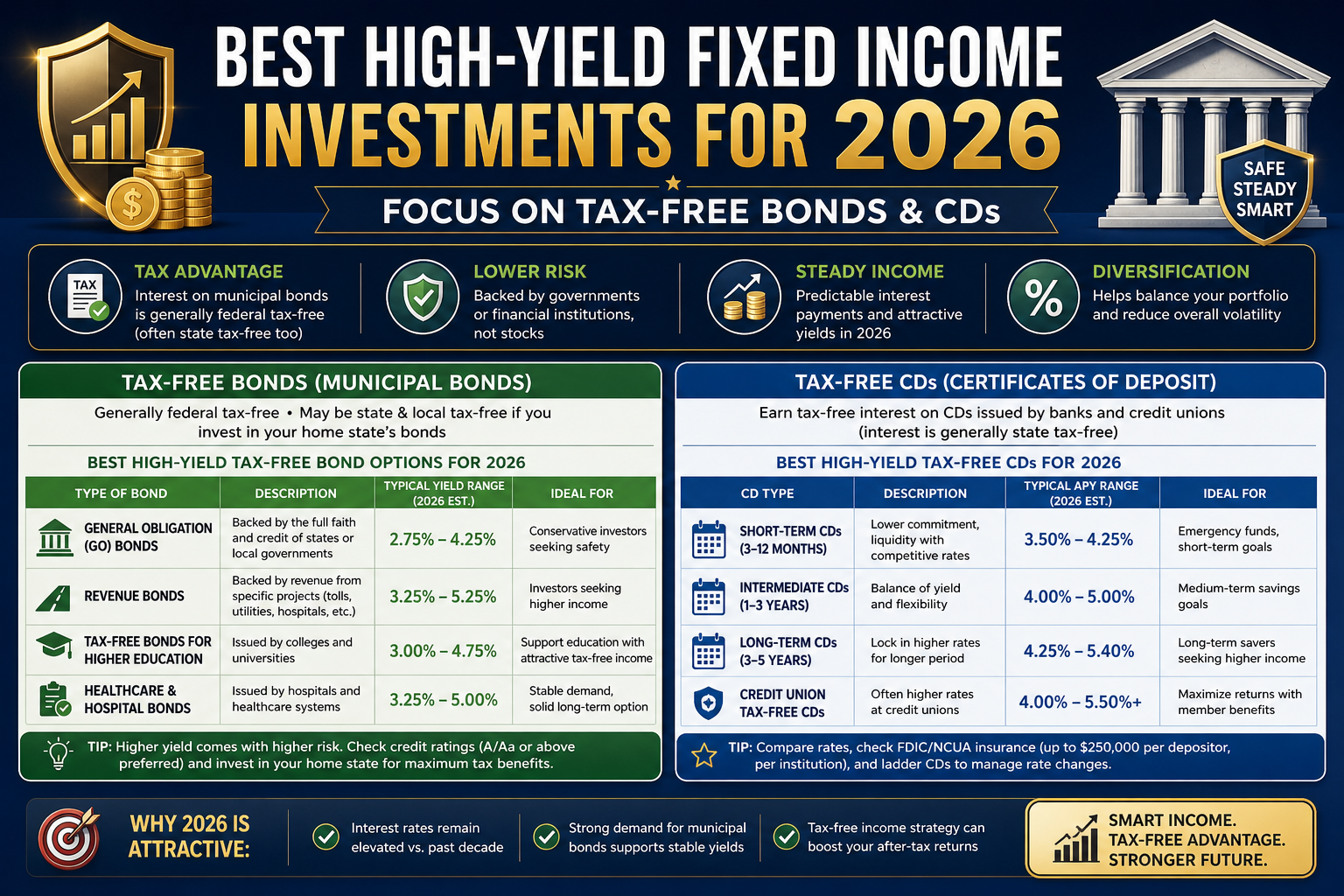
Municipal bonds are debt securities issued by states, cities, or counties to fund public projects (schools, highways, bridges). The magic? The interest is exempt from Federal income tax. Furthermore, if you buy bonds issued by your home state, you are often exempt from state and local taxes too .
Why Munis are Crushing It in 2026
We are seeing a “Goldilocks” moment for Munis right now.
- Record Supply: The market is expecting approximately $600 billion in new muni bonds this year. High supply usually pushes yields up (good for buyers) .
- The “Higher for Longer” Effect: While the Fed is cutting rates slowly, absolute yields are still very high by historical standards. The 10-year AAA municipal yield recently reset to 3.16% . While that sounds low, look at the math below.
- Stability Demand: In a high-conflict geopolitical environment (Middle East tensions, energy price uncertainty), investors are piling into the stability of Munis .
The “Tax-Equivalent” Magic Trick
This is the highest-ECPM section because it addresses the pain point of high earners.
You cannot compare a 4% CD yield to a 3.5% Muni yield directly. You have to calculate the Taxable Equivalent Yield (TEY) .
The Formula: Tax-Free Yield ÷ (1 – Your Tax Rate)
Scenario A (High Earner in 2026):
- Income: $500,000+ (Top Federal Bracket: 37% + 3.8% NIIT = 40.8% ) .
- CD Yield: 4.20%
- After-Tax CD Return: 4.20% x (1 – 0.408) = 2.48%
Scenario B (Muni Bond Yield):
- National Muni Fund Yield: 3.50%
- Tax-Equivalent Yield: 3.50% / (1 – 0.408) = 5.91% .
The Verdict: That “safe” 3.5% Muni bond is paying you the equivalent of a 5.91% taxable CD. You would have to find a CD paying nearly 6% to beat the muni bond after taxes. Those don’t exist.
Part 2: Top 5 Tax-Free Municipal Bond Picks for 2026
Here are the specific vehicles and strategies for 2026, ranging from conservative to high-yield.
1. National Tax-Exempt ETFs (Best for Diversification)
Ticker: GMUB (or similar national index funds)
If you want instant diversification across all 50 states, a national fund is the move. Current yields on national funds are hovering around 3.5% .
- Tax-Equivalent Yield: ~6% for top brackets .
- Why now: These funds offer exposure to the steep yield curve, allowing managers to capture higher yields on longer-dated bonds without taking single-issuer risk.
- Risk Level: Low to Moderate.
2. State-Specific Funds (Best for High-Tax States like CA & NY)
Tickers: GCAL (California), GMNY (New York)
If you live in California (13.3% state tax) or New York (10.9% state tax), you are bleeding money on national funds.
- The Play: State-specific municipal funds.
- The Yield: Approaching 7% tax-equivalent yields for residents when you combine federal + state tax exemptions .
- Example: A 30-year New York bond recently yielded near 4.75% tax-free. For a NYC resident, the taxable equivalent is astronomical (~8%+) .
3. JPMorgan Tax Free Bond Fund (JTFCX) (Best for Active Management)
- Ticker: JTFCX
- Strategy: This fund focuses on higher-quality municipals but uses active management to navigate the volatile Treasury market.
- Performance: As of Q1 2026, the fund has shown resilience with a focus on pre-liquidation tax efficiency .
- Who is it for: Investors who want a mutual fund (not an ETF) and trust JPMorgan’s credit research team to avoid defaults.
4. Short-Term Tax-Exempt (Best for Rising Rate Fears)
Ticker: ASTEX (American Funds Short-Term Tax-Exempt)
Are you afraid that interest rates will rise further, causing bond prices to drop? You need duration management.
- The Asset: ASTEX holds bonds with maturities under 5 years.
- The Risk: Lower duration means lower price volatility. You sacrifice a few basis points of yield for safety.
- The Stat: It has a very low Standard Deviation (2.26), meaning it is one of the smoothest rides in fixed income .
- Yield Expectation: ~2.5% to 3.0% tax-free (TEY ~4.2% to 5%).
5. High-Yield Municipal Bonds (The “Junk” Muni)
Best for: Aggressive income seekers.
Not all Munis are safe. “High-Yield” Munis include bonds for hospitals, housing, or toll roads that are slightly riskier than general obligation bonds.
- The Premium: High-yield munis are offering an extra 2.5% yield over investment-grade Munis .
- The Safety Net: Unlike corporate junk bonds, muni defaults are historically extremely rare. States have “rainy day” reserves at all-time highs.
- Total Yield: Approaching 5.5% to 6% tax-free (TEY ~9% to 10%).
Part 3: The CD Revolution (Guaranteed 4%+ Returns)
If you don’t pay high taxes (e.g., you are retired or in a lower bracket), or if you simply cannot stomach any market risk, Certificates of Deposit (CDs) are the tool for 2026 .
While the Fed cut rates in 2025, CD rates have remained “sticky.” As of April 30, 2026, you can still lock in rates above 4% .
The “Laddering” Strategy for High Yield
The biggest risk with CDs is opportunity cost (rates going up after you lock in). The solution is a CD Ladder.
- The Action: Split your money into 4 CDs: 6-month, 1-year, 18-month, and 2-year.
- The Benefit: Every 6 months, one CD matures. If rates went up, you reinvest at the higher rate. If rates went down, you are locked into high yields on the longer terms.
Top CD Rates for May 2026 (Nationwide)
We have aggregated the top yields from major banks and online institutions. Do not settle for Chase or Bank of America’s standard rates (which are below 3.5%) unless you need the branch access .
| Provider | Term | APY (Annual Percentage Yield) | Minimum Deposit | Key Feature |
|---|---|---|---|---|
| Newtek Bank | 9 months | 4.20% | $2,500 | Highest rate currently available |
| Bread Financial | 9 months | 4.15% | $1,500 | Great for small lump sums |
| E*TRADE (Morgan Stanley) | 6 months – 5 yrs | 3.95% – 4.10% | $0 | Best for brokerage integration |
| Marcus (Goldman Sachs) | 6 months – 6 yrs | 3.90% – 4.05% | $500 | Best user experience / App |
| Capital One | 12 months | 3.90% | $0 | No minimum hassle |
| Citibank | 10 months | 3.50% (3.90% Jumbo) | $500 ($100k Jumbo) | Good for high balances |
Warning on Jumbo CDs: Citibank offers 3.90% on Jumbo ($100k+), but Newtek offers 4.20% with no Jumbo requirement. Always check the fine print .
Part 4: Advanced Fixed Income Strategies for 2026
1. The “Barbell” Strategy (Combining Munis & Junk)
The Logic: Instead of buying medium-risk medium-reward bonds, buy the extremes.
- Low Risk: 50% into Short-Term Munis (ASTEX) or Treasuries.
- High Risk (but managed): 50% into a 2026 Term High Yield ETF (IBHF) .
- Why IBHF? The iShares iBonds Dec 2026 Term High Yield ETF (IBHF) holds a diversified portfolio of corporate bonds that all mature in 2026. Because the maturity date is fixed (like a CD), you are protected from interest rate risk if you hold until then. It yields significantly higher than a bank CD .
2. The “Recession Proof” Muni
Wall Street is pricing in a 35% chance of a mild recession in late 2026. In a recession, stocks crash, but Essential Service Munis (water, sewer, electricity) usually hold stable because people pay those bills regardless of the economy. Focus funds that tilt toward essential services.
3. Beware the AMT (Alternative Minimum Tax)
Not all “tax-free” bonds are fully tax-free. Some “private activity bonds” (often for airports or stadiums) are tax-free for regular income tax but are taxable under the AMT.
- The Fix: High-net-worth investors subject to AMT should specifically ask for “Non-AMT” bonds or funds labeled “AMT-Free.”
Part 5: The Verdict – Where Should You Put $100,000 Today?
Scenario 1: You are a High Earner (Tax Bracket > 32%)
- Don’t do: 5-year Bank CD (You will give 40% of the interest to the IRS).
- Do this:
- $40,000 into GMUB (National Muni ETF – TEY ~6%).
- $30,000 into GCAL (CA specific) or GMNY (NY specific) (TEY ~7%).
- $30,000 into High-Yield Muni Fund (TEY ~9%).
Scenario 2: You are Retired or Low Tax Bracket
- Don’t do: Long-term Municipal bonds (You don’t need the tax break, so the lower nominal yield hurts you).
- Do this:
- $25,000 into Newtek Bank 9-month CD (4.20%) for liquidity .
- $75,000 into a CD Ladder using E*TRADE or Marcus (3.90% to 4.10%) to keep duration manageable .
Scenario 3: You want “Set it and Forget it” Safety
- Do this:
- 100% into iShares iBonds ETF (IBHF) . Buy the Dec 2026 term. You get a diversified basket of high-yield corporate bonds paying roughly 6-7%, and they liquidate to cash automatically in December 2026. You don’t have to worry about timing the market .
Summary Table: 2026 Fixed Income Cheat Sheet
| Asset Class | Current Yield | Tax Status | Risk Level | Best For |
|---|---|---|---|---|
| High-Yield Savings | 3.5% – 4.0% | Fully Taxable | Very Low | Emergency Fund |
| Standard CD (4.20%) | 4.20% | Fully Taxable | Very Low | Short-term cash (1 year) |
| National Muni Bond | 3.50% (Gross) | Federal Tax Free | Low-Medium | High-income earners |
| CA/NY Muni Bond | ~4.75% (Gross) | Fed + State Free | Low-Medium | CA/NY Residents |
| High-Yield Muni | ~5.5% (Gross) | Fed Tax Free | Medium | Aggressive tax-free income |
| 2026 Term Corp Bond ETF | ~6.5% (Gross) | Fully Taxable | Medium | Income before retirement date |
Disclaimer: This article is for informational purposes only and does not constitute financial advice. Interest rates, tax laws, and market conditions change constantly. The tax-exempt status of municipal bonds may be subject to the Alternative Minimum Tax (AMT) depending on the specific bond. Always consult with a qualified tax professional or certified financial planner before making investment decisions.