What Is Dedicated Hosting?
By now, you’ve probably heard of shared hosting, VPS hosting, and cloud hosting. Dedicated hosting sits at the very top of the hosting pyramid.
Dedicated hosting means your website gets an entire physical server to itself. Not a slice of a server. Not a virtual compartment. The whole machine—every CPU core, every gigabyte of RAM, every megabyte of storage—is yours alone.
There are no neighbours sharing your resources. No “noisy neighbour” effects where someone else’s traffic spike slows you down. No security risks from poorly coded websites on the same machine.
Think of dedicated hosting as owning a standalone mansion on its own private land. Compare that to shared hosting (an apartment with roommates), VPS (a townhouse in a community), or cloud (a luxury hotel with on-demand rooms).
With a dedicated server, you have complete control. You choose the operating system (Linux or Windows). You decide which software to install. You configure security exactly how you want. And you get guaranteed performance 24/7/365.
Who Should Use Dedicated Hosting?
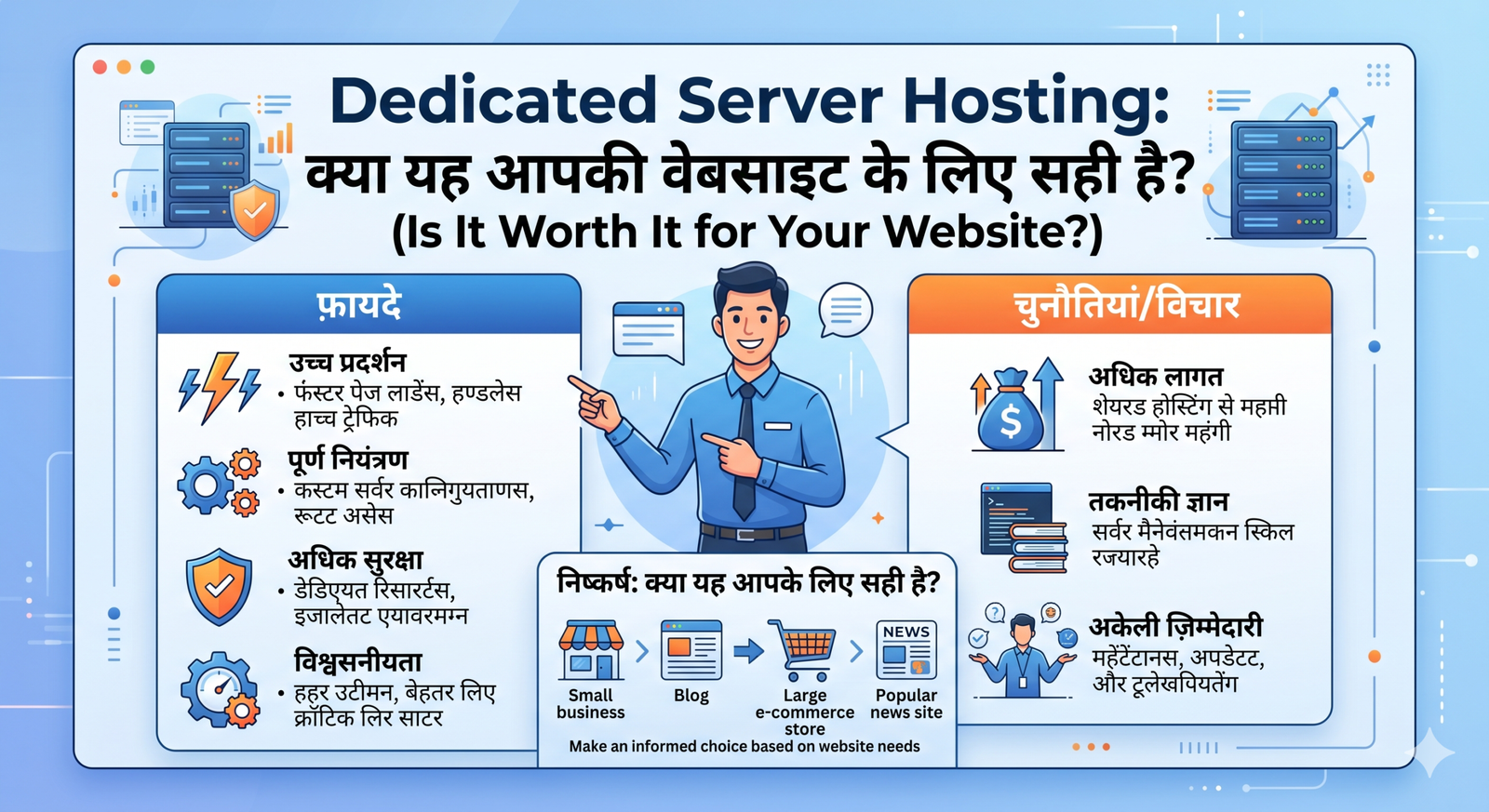
Dedicated hosting is not for everyone. In fact, for most website owners, it’s overkill. But for the right audience, it’s essential.
Dedicated hosting is best for:
- Large businesses with mission-critical websites (downtime costs thousands per hour)
- High-traffic websites receiving over 500,000 monthly visitors
- Enterprise-level projects requiring custom software or unique server configurations
- ECommerce giants processing thousands of transactions per hour
- SaaS platforms serving enterprise clients with strict uptime guarantees
- Government or healthcare websites handling sensitive data (HIPAA or FedRAMP compliance)
- Game servers or real-time applications needing consistent low latency
- Agencies hosting dozens or hundreds of client websites
Who should AVOID dedicated hosting:
- Small business websites (under 50,000 monthly visits)
- Personal blogs or portfolios
- Local restaurant or service business sites
- Startups on a tight budget
- Anyone without server administration experience (unless choosing managed dedicated)
For those users, shared hosting, VPS, or cloud hosting offers more than enough performance at a fraction of the cost.
Benefits of Dedicated Servers
There’s a reason dedicated hosting is the gold standard for enterprise websites. Here are the concrete benefits you get for the higher price.
1. Full control
You have root (administrative) access to the entire server. Install any software, modify any configuration file, run any application. No hosting provider telling you what you can or cannot do.
2. Maximum performance
All server resources are yours alone. No contention. No throttling. Popular websites load instantly. Database queries run in milliseconds. Even during peak traffic, performance remains consistent.
3. High-level security
Because no other websites share your server, the attack surface is dramatically smaller. You can implement custom firewalls, intrusion detection systems, and security protocols. For industries with compliance requirements (PCI-DSS for payments, HIPAA for healthcare, GDPR for European users), dedicated servers are often mandatory.
4. Unlimited customisation
Need a specific PHP extension? Want to run an older version of MySQL? Require a particular Apache module? On shared or VPS hosting, you’re limited by what the provider offers. On a dedicated server, you can configure everything.
5. Dedicated IP address (often multiple)
While most hosts provide a dedicated IP, dedicated servers typically include a block of IPs (5, 13, or even 29). This is essential for running multiple SSL certificates, setting up private email servers, or hosting many websites.
6. High traffic capacity
A properly configured dedicated server can handle millions of monthly visitors. Popular news sites, major eCommerce stores, and large forums all run on dedicated infrastructure.
The Downsides (Be Honest With Yourself)
Dedicated hosting isn’t perfect. Here’s what you sacrifice:
Higher cost: Expect to pay 80–500+ per month. That’s 10–50x more than shared hosting.
Technical expertise required: Unless you pay for “fully managed” (which costs even more), you need server administration skills to set up, secure, and maintain the server.
Responsibility: You (or your team) are responsible for security patches, software updates, backups, monitoring, and troubleshooting. If something breaks, you fix it.
Overkill for most sites: The vast majority of websites never need dedicated resources. A good VPS or cloud plan can handle 100,000+ monthly visitors comfortably.
Top Dedicated Hosting Providers for 2026
If you’ve decided dedicated hosting is right for your website, these are the best providers serving the US market.
| Provider | Best For | Starting Price | Key Feature |
|---|---|---|---|
| Liquid Web | Enterprise & mission-critical | $100+/mo | Fully managed with 24/7/365 support |
| Bluehost | Beginners entering dedicated | $80/mo | Easy setup + familiar dashboard |
| HostGator | Flexible configuration | $90/mo | Custom configs + multiple OS options |
Liquid Web – Best for Enterprise & Mission-Critical Websites
Liquid Web is widely considered the gold standard for dedicated server hosting. They don’t try to be the cheapest—they try to be the best. And for businesses where uptime and performance directly impact revenue, Liquid Web is worth every penny.
What makes Liquid Web exceptional:
- Fully managed – Liquid Web handles server setup, security patches, monitoring, and even some application-level support
- 100% uptime guarantee – If your site goes down, you get service credits (unheard of in hosting)
- 24/7/365 Heroic Support – US-based, answer in under 60 seconds, with actual server experts
- Free DDoS protection – Enterprise-grade mitigation included
- Free backups – Daily automated backups with 30-day retention
- Choice of data centres – US locations in Michigan, Arizona, and Virginia
Liquid Web’s dedicated servers start around 100/monthforbasicconfigurationsandgoupto500+ for high-performance setups. All plans are fully managed, making them perfect for business owners who need dedicated power without hiring a server admin.
Best for: ECommerce stores doing over 1Minannualrevenue,SaaSplatforms,agencieshosting100+clientsites,andanybusinesswheredowntimecostsexceed500/hour.
Bluehost – Best for Beginners Entering Dedicated Hosting
Bluehost is famous for shared hosting, but they also offer surprisingly capable dedicated servers. Their dedicated plans are designed as an upgrade path for users who started with Bluehost shared or VPS and have outgrown those environments.
Why consider Bluehost dedicated:
- Familiar interface – Same Bluehost dashboard you already know
- Easy setup – Bluehost pre-configures the server with cPanel and essential software
- Free domain privacy – Keeps your personal information out of public WHOIS databases
- Free SSL certificate – Included on all plans
- 24/7 support – Not as deep as Liquid Web, but adequate for most needs
The trade-off? Bluehost dedicated servers are not fully managed. Basic server maintenance (security patches, OS updates) is your responsibility. However, Bluehost does handle hardware failures and network issues.
Best for: Growing businesses that started on Bluehost and want a familiar upgrade path without learning an entirely new hosting environment.
HostGator – Best for Flexible Configuration
HostGator’s dedicated server plans stand out for their flexibility. You can customise almost everything—CPU, RAM, storage type and size, operating system, control panel, and additional security features.
HostGator dedicated highlights:
- Choose your OS – CentOS, Ubuntu, Debian, or Windows Server
- Choice of control panel – cPanel/WHM or Plesk (additional cost)
- Hardware customisation – Pick your CPU cores, RAM, and RAID storage configuration
- Unmetered bandwidth – No surprise fees for high traffic volumes
- 99.9% uptime guarantee – Standard for the industry
- Free setup fee waiver – On certain contract lengths
HostGator offers both unmanaged and semi-managed options. Their “Managed Service” add-on includes server monitoring, security patching, and basic optimisation for an additional fee.
Best for: Technical users who want to customise their server hardware and software but don’t want to pay enterprise prices.
Dedicated vs VPS vs Cloud – Which One Do You Actually Need?
This is the most important question. Here’s a frank comparison:
| Feature | VPS Hosting | Cloud Hosting | Dedicated Server |
|---|---|---|---|
| Monthly cost | 20–100 | 10–200+ (variable) | 80–500+ |
| Resources | Virtual (guaranteed) | Virtual (elastic) | Physical (guaranteed) |
| Scalability | Moderate (upgrade plan) | Excellent (real-time) | Low (hardware change) |
| Control | High (root access) | High (root access) | Full (complete control) |
| Maintenance effort | Low–Moderate | Low (managed cloud) | High (unless fully managed) |
| Best traffic range | 10k–200k visits/mo | 5k–500k+ visits/mo | 500k–millions visits/mo |
| Compliance ready | No | Maybe (HIPAA tier) | Yes (with proper config) |
Simple decision guide:
- Under 50,000 monthly visits → VPS or cloud is enough
- 50,000–500,000 monthly visits → Cloud or entry-level dedicated
- Over 500,000 monthly visits → Dedicated server
- Processing transactions >$10k/day → Dedicated server
- Storing sensitive customer data → Dedicated server
- Need HIPAA, PCI, or FedRAMP compliance → Dedicated server
Final Thoughts
If your website handles massive traffic or sensitive data, dedicated hosting is worth the cost. The performance, security, and control are unmatched by any other hosting type.
But here’s the honest truth most hosting companies won’t tell you: For 95% of websites, dedicated hosting is overkill.
A well-configured VPS or cloud hosting plan can easily handle 100,000 monthly visitors. ECommerce stores processing hundreds of orders per day run perfectly fine on high-tier cloud hosting. Even popular blogs with millions of monthly readers often use cloud infrastructure, not dedicated servers.
So when should you choose dedicated?
Yes to dedicated hosting if:
- Your site consistently exceeds 500,000 monthly visitors
- You process sensitive data (credit cards, medical records, legal documents)
- Your business loses more than $500 for every hour of downtime
- You need custom server configurations impossible on cloud platforms
- Compliance requirements demand physical server isolation
Stick with VPS or cloud if:
- Your site gets under 200,000 monthly visitors
- You’re on a budget under $100/month
- You want hassle-free scalability (up or down)
- You don’t have a dedicated IT person or team
Our recommendation: Start with VPS or cloud. Only upgrade to dedicated when you absolutely need it. By then, your business will be large enough that the cost of a dedicated server is a small fraction of your revenue.
And if you do need dedicated hosting, choose Liquid Web for mission-critical sites where uptime is everything. Choose Bluehost if you’re upgrading from their shared or VPS plans. Choose HostGator if you want custom hardware configurations.
Your hosting should match your actual needs—not your ego, and not a salesperson’s commission. Choose wisely, and your website (and wallet) will thank you.
*Disclaimer: Prices shown reflect promotional rates for basic dedicated server plans as of 2026. Fully managed dedicated servers (like Liquid Web) cost more than unmanaged or semi-managed options. Always verify current pricing and contract terms before purchasing.*